
Oswego’s Hidden Crisis: Homelessness Surges in the Wake of COVID-19
OSWEGO, N.Y. — Homelessness in Oswego County has exploded in recent years, fueled by rising rents, a shrinking housing supply, and a post-pandemic economy that has left vulnerable residents with few options and fewer places to turn.
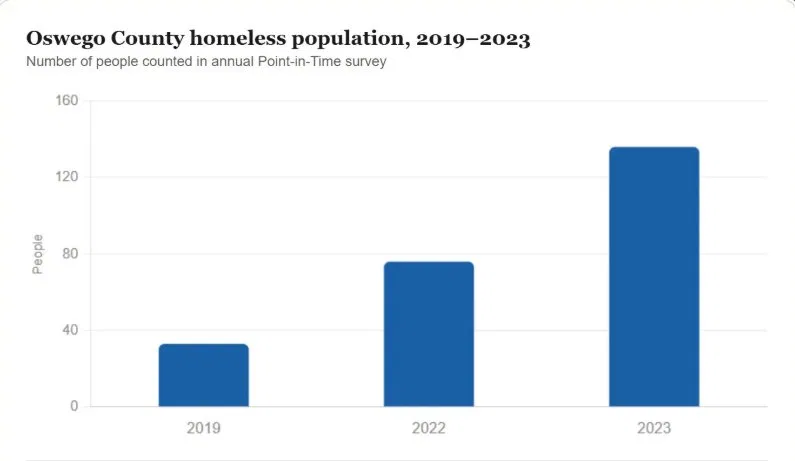
Homelessness in Central New York has increased more than 60% since 2019, and Oswego County’s numbers have risen by 310% over that same period, according to data from the Housing and Homeless Coalition of Central New York. The county’s homeless population jumped from 76 people in 2022 to 136 in 2023, a 161% increase from the 2019 baseline according to the 2024 Point-in-Time Count Report.
Those numbers, staggering on their own, may still undercount the true scale of the problem.
Homelessness in rural areas like Oswego County can be difficult to measure because it tends to be hidden. Rather than sleeping on city streets, unhoused people in rural communities often couch-surf, moving between other people’s homes when they can, which makes it harder to get an accurate picture of the problem, according to an article by Oswego County Business.
Mary Curcio, executive director of Victory Transformation, Oswego’s only certified men’s emergency shelter, has seen the crisis grow firsthand over her three years leading the organization.
“It’s almost like the perfect storm,” Curcio said. She pointed to COVID-19 as a turning point. Before the pandemic, she said, the average stay at a shelter ran about 45 days to two months. The wait to secure permanent housing has now stretched considerably.
“You’re talking about 6 to 9 months now to house people,” Curcio said. She noted that the director of a similar ministry in Buffalo reported nearly identical figures when she spoke with him at a recent event.
Curcio identified rising rental costs, a shrinking pool of available apartments, and compounding financial barriers as key drivers. She recalled a time when young adults could work 50 or 60 hours a week to save enough for a first month’s rent.
“I only had to come up with the first month’s rent,” she said. “Now you have a security deposit on top of that, and large corporations restrict hours to avoid paying benefits, so that’s kind of inhibiting the amount of money that people can earn.”
Education is another barrier, Curcio said, that is often overlooked. She estimated that only one or two of the 18 men housed at Victory Transformation at any given time hold a GED or diploma.
“If they’re in their 40s and they’re going to start trying to build wealth, working at places like McDonald’s, that’s typically what a teenager would start with,” she said. “That’s a problem.”
Substance abuse and mental health challenges compound the issue, Curcio added, noting that the pharmaceutical industry bears responsibility for damage felt not just in Oswego County but across the country.
Rural barriers deepen the divide:
Comparing Oswego County’s numbers to New York City’s reveals a striking gap in growth rates. The comparison is not apples to apples. Curcio pointed to the county’s rural geography as a significant obstacle. In a county stretching from the city of Oswego to remote hamlets like Orwell and Boylston, transportation is a persistent barrier to accessing services at the Department of Social Services or signing up for programs like HEAP, SNAP, or rental assistance.
“When you go way up north, it’s hard to get those people down to Mexico for resources,” Curcio said, referring to the town of Mexico, where the county’s DSS office is located. “That means people have to be educated to know how to use the system, maybe not to use the app, and when you’re talking about older people, or people who don’t have phones, it’s more difficult.”
Mobility management efforts through the county have helped, Curcio acknowledged, but the challenge remains, especially during Oswego County’s punishing winters.
A New Face of Homelessness:
The crisis is not just affecting single individuals. Across Cayuga, Onondaga, and Oswego counties, family homelessness has risen 192% since 2019. For the first time in more than a decade, families with children now make up the majority of the unhoused population in the region according to a CNY Central report.
Megan Stuart, director of the Housing and Homeless Coalition of CNY, said the data represents a major shift in what homelessness looks like. “It really is a big shift in what people typically think of homelessness,” Stuart said. “But really, what we’re seeing now are a lot of families who’ve never experienced homelessness before, finding themselves in that situation and needing emergency shelter because they have nowhere else to go.” WRVO
Curcio echoed the concern. As a retired school administrator and former math teacher, she said children experiencing homelessness staying in hotels while trying to attend school represent a particularly urgent challenge. “When you’re talking about children, that’s a whole other heartstring,” she said.
How to Help:
Victory Transformation, located at 24 E. Oneida St., is the only certified emergency men’s shelter in Oswego County. The organization also runs the county’s warming shelter in the basement of Pontiac and is preparing to open a second facility at 91 E. Fourth St. to serve men ages 18 to 24.
Curcio said the organization accepts monetary donations, particularly for utility costs, which have nearly doubled, as well as food that meets health code requirements. Volunteers with skills in construction and contracting are especially welcome.
Donations can be mailed to Victory Transformation, 24 E. Oneida St., Oswego, NY 13126 or you can also donate online today.
Those interested in volunteering can contact the organization directly to schedule an interview.
“Obviously, every person deserves a safe place to call home,” Curcio said.