
As Gas Prices Continue To Increase In America, A Resolution To The Madness Becomes More And More Murky
OSWEGO, N.Y- Gas prices are continuing to climb across the United States, and experts say drivers should not expect relief anytime soon. Global conflict, blocked oil supply routes and low oil reserves are all contributing to rising costs at the pump, creating concerns about what fuel prices could look like throughout the summer.
One of the biggest factors impacting gas prices is tension in the Middle East, particularly surrounding the Strait of Hormuz, one of the world’s most important oil shipping routes. A large amount of the global oil supply passes through the region, meaning any disruption can immediately affect energy markets worldwide.
“Gas prices have risen because of the U.S. attack on Iran, which has blocked one of the main oil supply lines,” said John Kane.
John Kane is a professor at SUNY Oswego, serving as a professor in the Economics department, and the Applied Mathematical Economics Program Coordinator. Just last year, Kane won the prestigious SUNY Distinguished Service Faculty rank. The rank is given to recognize exceptional contributions to the university, and beyond. Respected by many, Kane mapped out the current state of America’s gasoline dilemma for this piece.

He is certainly not wrong either. According to the “Trading Economics” summary on the fluctuation of gas prices, gasoline futures were above $3.60 per gallon- close to the four year high of $3.75 which was achieved on May 4th, 2026. Roughly a year ago; May 20, 2025 to be exact, the price was $2.06 USD/Gal. The numbers show an increase of about $1.64 on average. This only further solidifies that our country has a real problem.
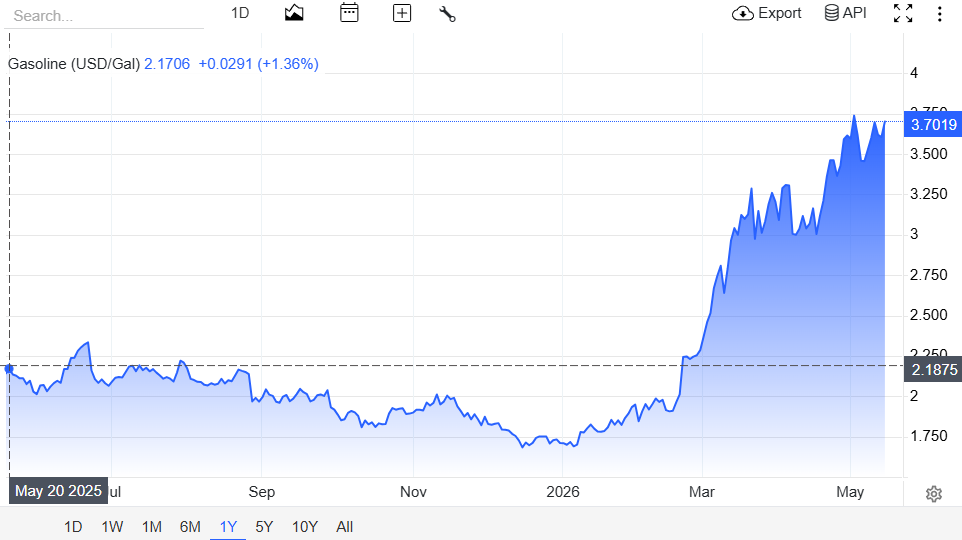
“Over the past month, Gasoline’s price has risen 17.01%, and is up 73.08% compared to the same time last year, according to trading on a contract for difference (CFD) that tracks the benchmark market for this commodity,” reads the website.
Gasoline accounts for a significant portion of the country’s overall oil demand, being the largest refined petroleum product consumed in the United States. As the main fuel for transportation, it is an important indicator of consumer activity and economic conditions. You can read more about it here https://tradingeconomics.com/commodity/gasoline
As uncertainty continues overseas, oil markets have responded with higher prices, which eventually reach consumers at local gas stations. Rising fuel costs can also impact the prices of groceries, shipping and travel because businesses are forced to spend more on transportation.
According to Kane, many people already understand why prices are increasing and how global politics are influencing the economy.
“I think that nearly everyone understands that this is the result of the war and Trump’s decision to continue a blockade in the Strait of Hormuz,” Kane said.
Even if tensions begin to calm down, experts warn that gas prices may remain elevated for an extended period. One reason is that global oil reserves are already running low, making it difficult for supply to recover quickly. A foreseeable resolution is not all that guaranteed either. President Trump has stated that the current ceasefire has grown fragile, thus dimming the likelihood of an agreement. It is anyone’s guess what will happen.