
Fire safety rule at SUNY Oswego reshapes residence hall culture
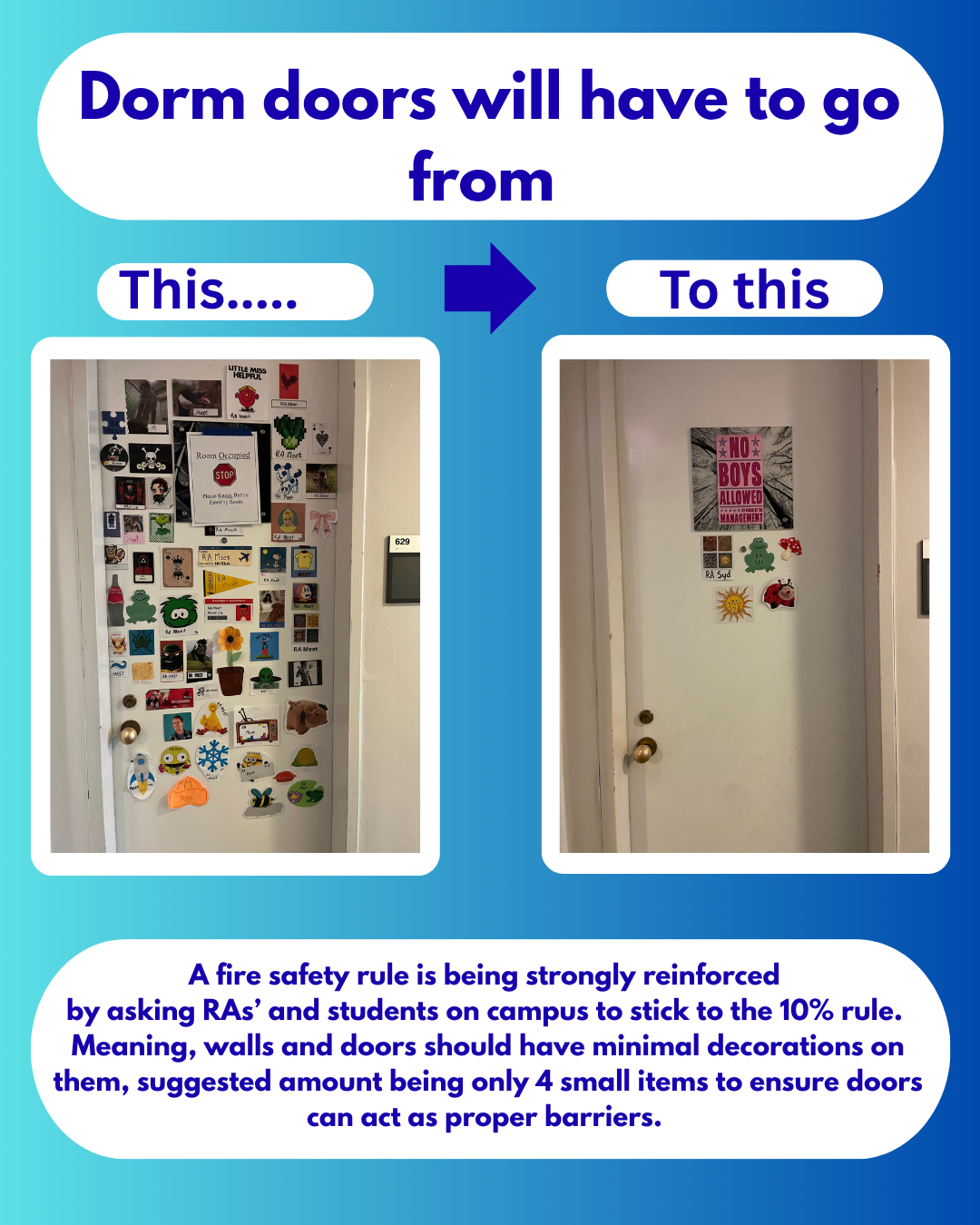
A new fire safety rule at SUNY Oswego is changing what students can put on their dorm room doors and for many Resident Assistants, it feels like more than just a policy update.
SUNY Oswego recently adopted stricter guidance based on direction from the State Fire Inspector, limiting decorations on doors and walls to 10% of the surface area. Because that percentage can be difficult to measure, the policy has been simplified into the “rule of four,” allowing only four small items per door.
From a fire safety standpoint, the reasoning comes down to how fires behave in enclosed spaces. Doors are meant to act as barriers that slow down flames, heat and smoke.
According to fire safety guidance explained by Fire Marshal Ken Ayhens, “It degrades the fire door because the fire has a fuel force [door decs and other paper decorations] right there at the fire door so it can burn with intensity.”
When decorations are added, especially flammable materials like paper, they can ignite quickly and weaken that barrier.
The 10% rule is not random. Fire codes often limit how much combustible material can be placed on walls and doors because once that threshold is exceeded, the risk of rapid fire spread increases. In a residence hall, where doors line hallways and rooms are close together, even small additions can build up and create a larger hazard.
Ayhens also mentioned that fire codes are made from research and looking at past fires and examining them to see what could have been prevented.
Ayhens focus throughout is on prevention and protecting people. His role centers on making sure small risks do not turn into dangerous situations, especially in places like residence halls where so many students live close together.
While the policy is grounded in safety, many RAs say it is frustrating in practice, especially because of how much time and effort goes into creating door decs.
“I think door decs create a very friendly environment,” Alex Duran, a Seneca Hall RA, said. “When people see my door, they can tell I have been an experienced RA by the amount of door decs I have.”
For many, these decorations are not just visual. They represent identity, effort and connection with residents.
“Each door dec has its own meaning, its own value,” Seneca RA Meet Patel said. “When we had to take them down, we felt it.”
RAs also pointed out that they are often required to make new door decs multiple times a year, making the restriction feel even more discouraging.
“It is work we are putting in,” Patel said. “But at the same time, they do not want us to show it or use it to build community.”
Others said the rule impacts how they connect with residents on a personal level.
“I use my door decs to express myself and show my residents who I am in a nonverbal way,” Nathaniel Miller, a Seneca RA, said. “Limiting that makes it harder for them to feel comfortable.”
Students also raised practical concerns, like how door decs help identify RA rooms.
“It is harder to find the RA’s door now,” Seneca RA Elizabeth Venette said. “And I do not want to have to pick favorites of which ones I keep up.”
The policy does not just affect RAs. Residents are also feeling the impact, especially when it comes to personal expression and making their space feel like home.
“I know some of the residents have photography and pictures that they have taken that they are not able to have on their doors,” Miller explained. “They already have their normal decorations, so now they have to limit what they can show.”
Even with the frustration, the rule reflects a broader challenge colleges face, balancing safety requirements with student experience. Fire safety policies are designed to prevent worst case scenarios, even if the risks are not always visible in everyday life.
Ayhens notes, “It is so important for us to get out there and talk to students one on one. That’s why I have my Peer Safety Guardians, so they can be out there to talk student-to-student and peer-to-peer.”
As residence halls adjust to the 10% rule, RAs are left finding new ways to build community without relying as much on door decorations. Bulletin boards, events and face to face interaction may take on a bigger role moving forward.
Still, something as simple as a decorated door is proving to matter more than expected. For many students, it was never just decoration. It was part of what made the dorm feel like home.